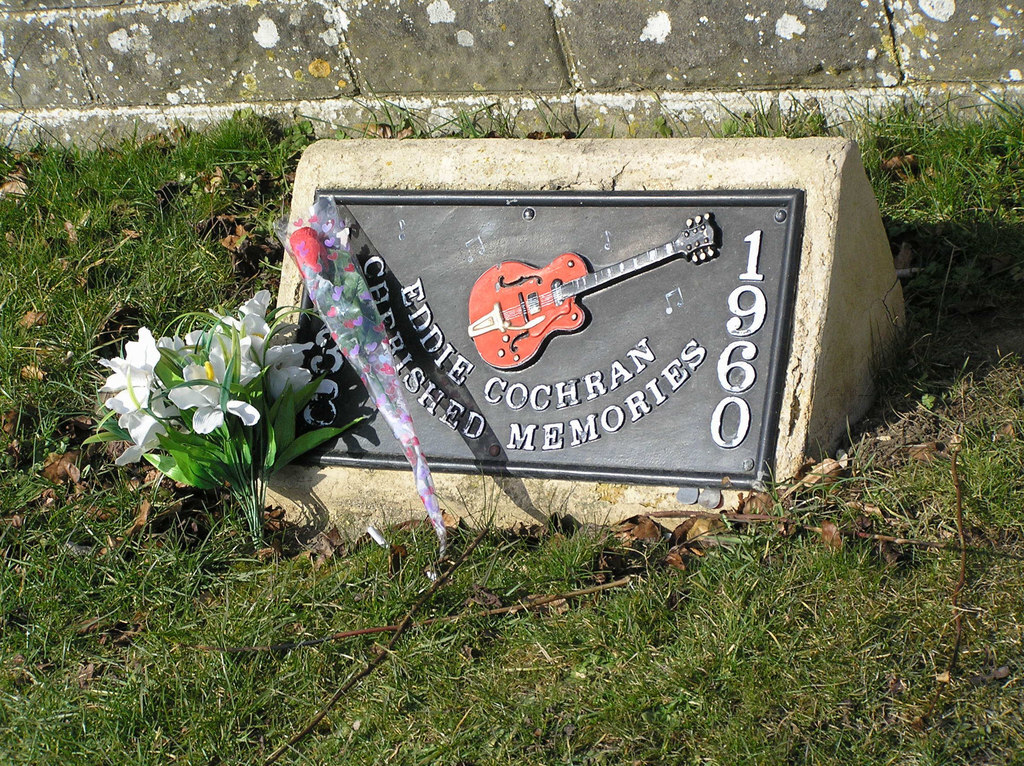
What happened here?
On the evening of 16 April 1960, Eddie Cochran played his final concert at the Bristol Hippodrome — the last date of a UK tour that had been extended from five weeks to fifteen. He shared the bill with Gene Vincent on what was Britain's first major rock 'n' roll package tour. Afterwards, a taxi was booked to take Cochran, Vincent, Cochran's fiancée Sharon Sheeley, and tour manager Patrick Tompkins to London Heathrow for a flight home to the United States.
Late that night, the taxi blew a tyre on the A4 just past the viaduct at Rowden Hill in Chippenham, Wiltshire. The car lost control and struck a lamppost. Cochran, who had attempted to shield Sheeley, was thrown from the vehicle and suffered massive head injuries. He was taken to St Martin's Hospital in Bath, where he died the following morning, 17 April 1960. He was 21 years old. Gene Vincent survived but suffered lasting injuries to an already damaged leg. Sheeley and Tompkins also survived.
The taxi driver, George Martin, was later convicted of dangerous driving, fined £50, disqualified from driving for fifteen years, and sentenced to prison. Cochran's current single at the time of his death was "Three Steps to Heaven," which went to number one in the UK after the crash.
Cochran had recorded only a handful of songs — "Summertime Blues," "C'mon Everybody," "Somethin' Else," "Twenty Flight Rock" — but their influence was immense. Paul McCartney auditioned for John Lennon's band by playing "Twenty Flight Rock"; without Cochran, there may not have been a Beatles. His guitar playing, his attitude, and his instinct for teenage rebellion laid groundwork that British rock 'n' roll would build on for the next decade.
A memorial plaque was erected at the crash site on Rowden Hill in 1990. In 2018, it was re-set into a larger monument composed of three steps — each inscribed with lyrics from "Three Steps to Heaven." A blue plaque was also unveiled at the Bristol Hippodrome in 2023, marking the venue where Cochran played his last show. The Rowden Hill site remains a quiet pilgrimage spot, tucked into a bend in the road at the foot of the hill where the lamppost once stood.