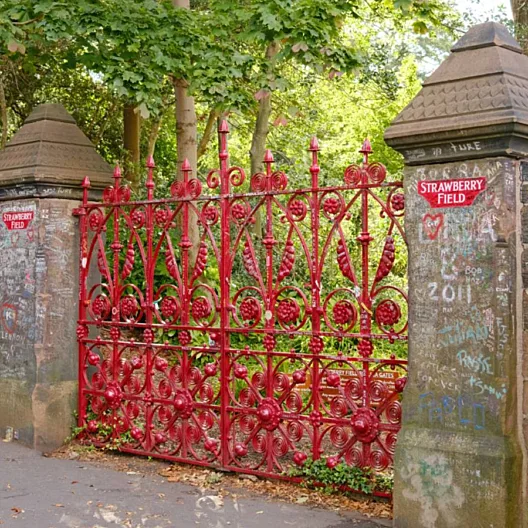
Strawberry Field, Liverpool
The Salvation Army garden that inspired Strawberry Fields Forever — now open to the public
Beaconsfield Road
Liverpool, United Kingdom
53.3800° N · -2.8834° W
Get DirectionsWhat happened here?
Strawberry Field was a Salvation Army children's home on Beaconsfield Road in the Liverpool suburb of Woolton, adjacent to the grounds of which John Lennon played as a child — his Aunt Mimi's house at 251 Menlove Avenue being less than a five-minute walk away. The estate had gardens that were open to local children in summer, and Lennon attended the annual fete there as a boy. The specific emotional resonance of the place for him — the sense of a bounded, protected space he could enter and leave, separate from the tensions of his childhood — found its way into the song.
Strawberry Fields Forever
"Strawberry Fields Forever," recorded in November and December 1966 and released as a double A-side single with "Penny Lane" in February 1967, is not a straightforward nostalgia piece. Lennon described it as an attempt to communicate a feeling he struggled to express directly: a sense of placelessness, of inhabiting a different reality from other people, of comfort and disorientation existing simultaneously. The Strawberry Field gardens were the childhood correlative of that feeling — a place he could go that was simultaneously real and imagined, a refuge that was always partly a mental state.
The Gates
The gates themselves, bearing the name 'Strawberry Field' in iron lettering, became a pilgrimage site for Beatles fans from around the world. The property remained a Salvation Army care facility for decades after Lennon's death. It was on these same streets that Lennon first met Paul McCartney in 1957, at the St Peter's Church fete in Woolton — a meeting that would change the course of popular music.
Visiting Today
The Salvation Army children's home closed in 2005. Following extensive restoration, the site reopened in 2019 as Strawberry Field — a visitor centre and social enterprise that provides training for young adults with learning disabilities. The famous red iron gates from Lennon's childhood, which had become a pilgrimage site in their own right, were restored and reinstalled. The gardens are now open to the public. It is the most substantial Beatles heritage site in Woolton and one of the most visited music landmarks in Liverpool.
Strawberry Field was a Salvation Army children's home on Beaconsfield Road in the Liverpool suburb of Woolton, adjacent to the grounds of which John Lennon played as a child — his Aunt Mimi's house at 251 Menlove Avenue being less than a five-minute walk away. The estate had gardens that were open to local children in summer, and Lennon attended the annual fete there as a boy. The specific emotional resonance of the place for him — the sense of a bounded, protected space he could enter and leave, separate from the tensions of his childhood — found its way into the song.
Strawberry Fields Forever
"Strawberry Fields Forever," recorded in November and December 1966 and released as a double A-side single with "Penny Lane" in February 1967, is not a straightforward nostalgia piece. Lennon described it as an attempt to communicate a feeling he struggled to express directly: a sense of placelessness, of inhabiting a different reality from other people, of comfort and disorientation existing simultaneously. The Strawberry Field gardens were the childhood correlative of that feeling — a place he could go that was simultaneously real and imagined, a refuge that was always partly a mental state.
The Gates
The gates themselves, bearing the name 'Strawberry Field' in iron lettering, became a pilgrimage site for Beatles fans from around the world. The property remained a Salvation Army care facility for decades after Lennon's death. It was on these same streets that Lennon first met Paul McCartney in 1957, at the St Peter's Church fete in Woolton — a meeting that would change the course of popular music.
Visiting Today
The Salvation Army children's home closed in 2005. Following extensive restoration, the site reopened in 2019 as Strawberry Field — a visitor centre and social enterprise that provides training for young adults with learning disabilities. The famous red iron gates from Lennon's childhood, which had become a pilgrimage site in their own right, were restored and reinstalled. The gardens are now open to the public. It is the most substantial Beatles heritage site in Woolton and one of the most visited music landmarks in Liverpool.
Plan your visit
Nearby cafés & pubs
Museum
Fan pilgrimage site
Ticket required
Other landmarks nearby
Reviews
Been here? Tell us about it
You've already reviewed this landmark.