What happened here?
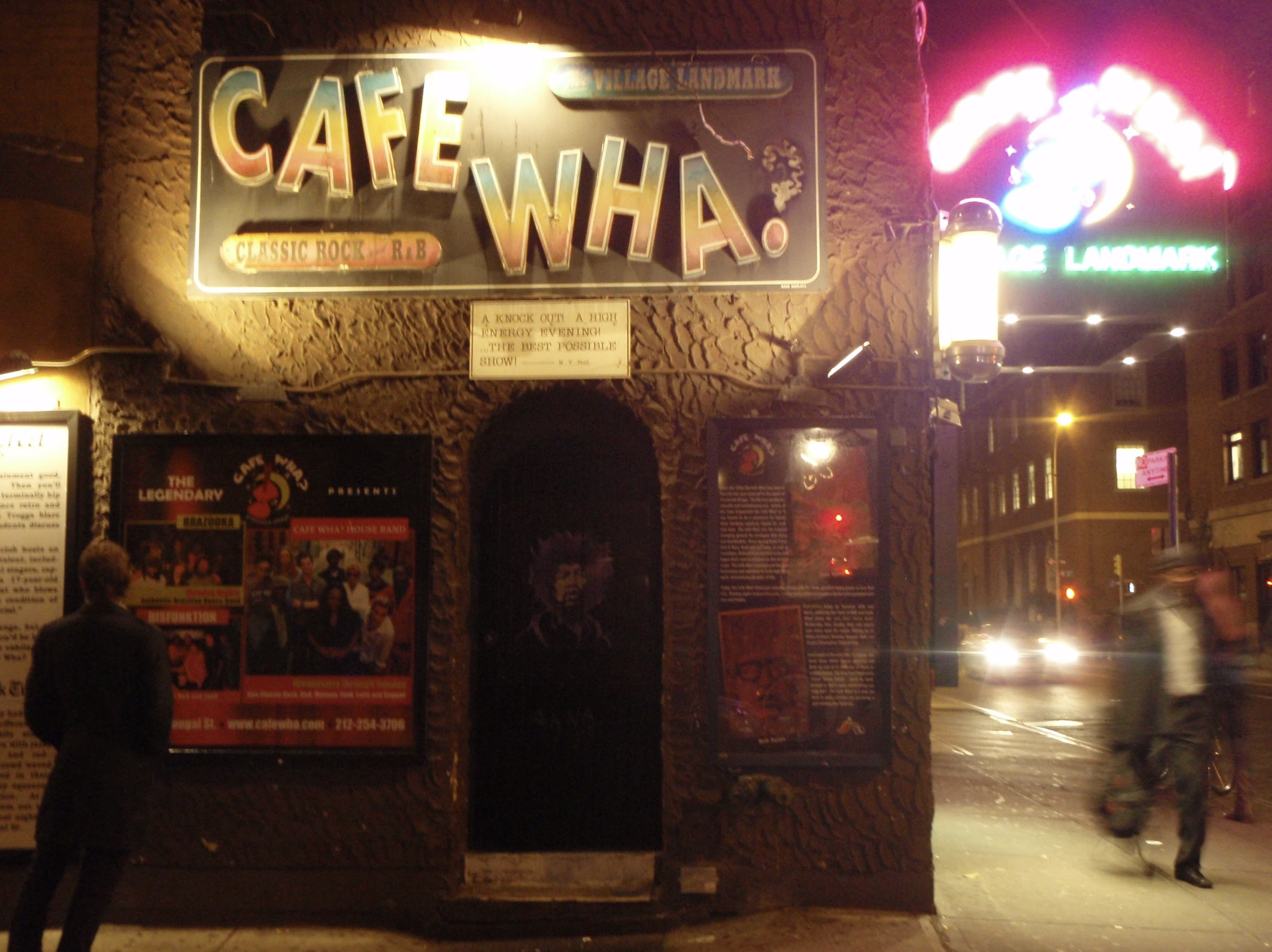
Cafe Wha? at 115 MacDougal Street in Greenwich Village has been a launching pad for some of the biggest names in music since it opened in 1959. Founded by Manny Roth — an actor and World War II veteran — the basement venue was formerly a horse stable. Roth laid the marble tile himself and turned the subterranean space into one of the most important clubs of the 1960s folk and rock era.
Bob Dylan first performed at Cafe Wha? on 24 January 1961, playing a hootenanny night shortly after hitchhiking across the country to New York. He was nineteen years old. Dylan continued to play the club as a backup harmonica player during afternoon sets. In his memoir Chronicles: Volume One, he described it as "a subterranean cavern, liquorless, ill lit, low ceiling, like a wide dining room with chairs and tables." Performers were often paid through baskets passed among the audience.
Five years later, on the recommendation of folk singer Richie Havens, Roth hired Jimi Hendrix as a recurring performer. Billed as "Jimmy James and the Blue Flames," Hendrix played five sets a night, six nights a week through the summer of 1966. It was here that Chas Chandler — bassist for The Animals — saw Hendrix perform and convinced him to come to England. Within months, Hendrix was recording "Hey Joe" in London, and the rest followed.
The club also hosted early performances from Bruce Springsteen, Richard Pryor, Woody Allen, and Bill Cosby, among many others. Throughout the 1960s it operated as both a coffee house and music venue, sitting at the heart of the Greenwich Village scene alongside the Bitter End, the Gaslight Cafe, and Gerde's Folk City — all within a few blocks of each other on MacDougal and Bleecker Streets.
Cafe Wha? is still open and operating as a live music venue. The house band performs Wednesday through Sunday, and the space retains its basement club feel — entered down a steep staircase from street level. It sits on one of the most storied blocks in American music history, and remains a working venue rather than a museum, which is part of its appeal.